
My practice has so far moved across AI-generated imagery, short film, sound, collage, editorial design and public-facing creative projects. Recently, it entered another form: long-form fiction.
Δυσκολεύτηκες να με βρεις; (Was It Hard to Find Me?) is a 14,500-word Greek-language novella developed through an experiment in generative writing, human creative direction and editorial control. The completed book runs to approximately 156 pages in a 5 × 8-inch format and is currently being prepared for independent publication.
This was not an attempt to suddenly present myself as a novelist. It began as a practical question: could I use generative AI to build a complete literary work while retaining enough control over its emotional logic, voice and internal world for the result to feel deliberate and human?
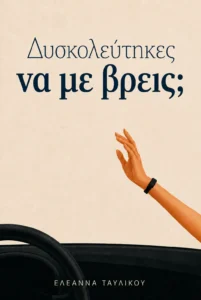
The cover of Δυσκολεύτηκες να με βρεις;, designed as part of the novella’s wider visual and editorial identity.
Beginning with Familiar Ground
For this first experiment, I deliberately chose subject matter that I could evaluate from experience.
The novella is centred on relationships, separation and the conversations people postpone even when they know that avoiding them changes nothing. Although the characters and events are fictional, the emotional territory draws from transformed personal observations, stories shared by friends and situations accumulated over time.
Working within this familiar territory gave me a point of reference. I could recognise when a reaction felt emotionally false, when a line sounded written rather than spoken, or when a scene technically made sense but lacked the tension and contradiction of an actual relationship.
I made a similar decision about location. The story is set in Veria, the city where I live and which I know in physical detail. Streets, distances, summer heat, traffic patterns and familiar places became more than background. They gave me another system through which I could test the generated material.
If the text misplaced a location, misunderstood the distance between two points or described the environment in a way that did not correspond to the real city, I could identify it immediately. Emotional familiarity and geographic familiarity both became forms of creative control.
The result is fiction, but fiction built within conditions I could continuously examine.
From an Idea to a Working Structure
I began with the central premise, the characters, the opening scene, the ending and the emotional direction of the story. What I did not have was formal training in creative writing or a clear technical method for organising those elements into a complete novella.
Claude became the primary text-generation tool, helping turn an initial accumulation of scenes, observations and intentions into a workable narrative structure. ChatGPT was also used during the broader development and editorial process.
The prose was predominantly AI-generated, but it was never treated as finished material. Every chapter was followed by close reading and another editorial cycle. I reviewed the text paragraph by paragraph and often sentence by sentence, keeping notes in separate documents before returning with grouped corrections, new directions or exact replacement wording.
Some interventions were small. A single word might carry the wrong cultural tone or feel inconsistent with the way I would naturally describe something in Greek. Others involved complete expressions, emotional reactions, dialogue exchanges or entire scenes that did not yet feel convincing.
There was no section of the finished book that passed through the process without review.
Building a System Around the Story
As the novella developed, the process required more than a single manuscript.
I created and repeatedly updated a story Bible containing the timeline, character behaviour, recurring objects, structural movements and rules governing the narrative voice. A separate document, titled Πυξίδα (Compass), acted as a strategic framework. It held the central premise, thematic direction, intended reading experience and a set of criteria through which new scenes could be tested.
Among those criteria were simple but demanding questions. Does this feel like something a person would actually do? Does the emotion emerge through action and detail, or is the text explaining too much? Does the scene leave enough space for the reader to form a judgement? Does it serve the central tension of the book?
Both documents changed as the story changed. The Bible alone went through at least four recorded versions, with new information added, contradictions corrected and earlier decisions reconsidered.
This evolving structure allowed me to work with AI without surrendering the continuity of the project to it. The system could generate possibilities, organise information and point out structural consequences. It could not decide which emotional detail felt true, which silence carried meaning or which imperfection needed to remain.
Editing for Emotional Truth
One of the most useful aspects of the process was the way AI could impose order on the initial chaos of my thinking.
I began with a strong sense of what the story should contain and how the characters should feel, but not with the technical knowledge required to shape that material into a sustained literary form.
At times, the system also explained why a requested change might confuse the reader, disrupt the established point of view or weaken the structure. It could then offer alternatives. That exchange became part of the editorial process rather than an instruction followed without question.
The opposite was equally important. A technically coherent suggestion could still be wrong for the story.
Generated prose often needed to be brought back towards more natural Greek, greater emotional restraint or a rhythm that allowed objects, pauses and environmental details to carry what the characters could not say directly.
The story gradually became less concerned with whether two people might simply reunite and more concerned with acknowledgement. Its central character is not looking only for reconciliation. She needs an experience to be recognised and named without being minimised, reinterpreted or avoided.
At the same time, receiving that acknowledgement requires her to confront her own form of avoidance and remain inside the conversation she has repeatedly escaped.
The deeper choice is not only between two people. It is between repetition and self-awareness.
Designing the Book as an Object
The experiment did not end with the manuscript. It extended into editorial and visual design.
I developed the cover around the gesture at the centre of the story: a hand raised towards a passing car. The image is viewed from inside the vehicle, with the dark dashboard occupying the lower part of the composition and the figure’s hand suspended against the bleached light of a late-August morning.
The restrained colour palette, typography and physical proportions were designed to preserve the novella’s tension between stillness and impulsive action.
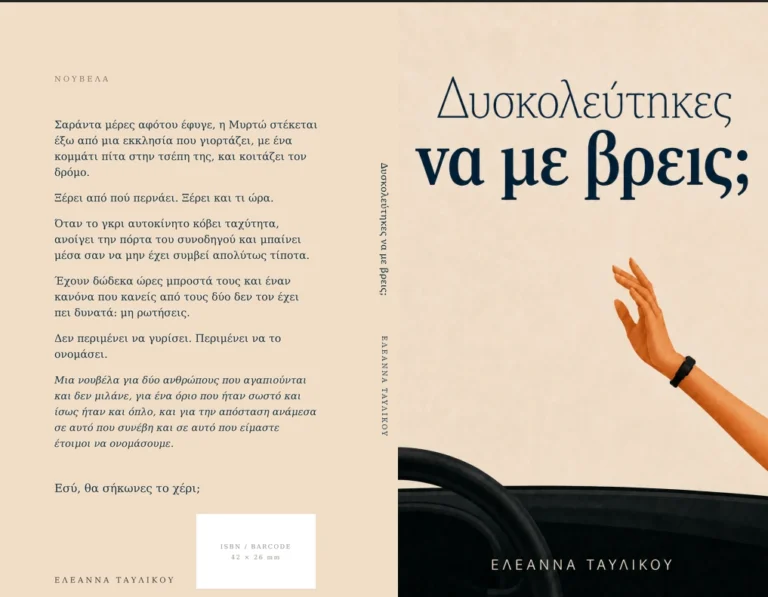
The complete cover design, including the front, spine and back-cover composition.
The back cover introduces the emotional premise without resolving it:
Forty days after leaving, Myrto stands outside a church during its annual celebration, with a piece of pie in her pocket, watching the road.
She knows where he passes. She also knows when.
The book’s Greek title, Δυσκολεύτηκες να με βρεις;, translates approximately as Was It Hard to Find Me? It carries the lightness of an ordinary question while holding something unresolved beneath it.
The full cover, spine, back-cover text and interior typesetting were treated as parts of the same work rather than as packaging added after the writing was complete.
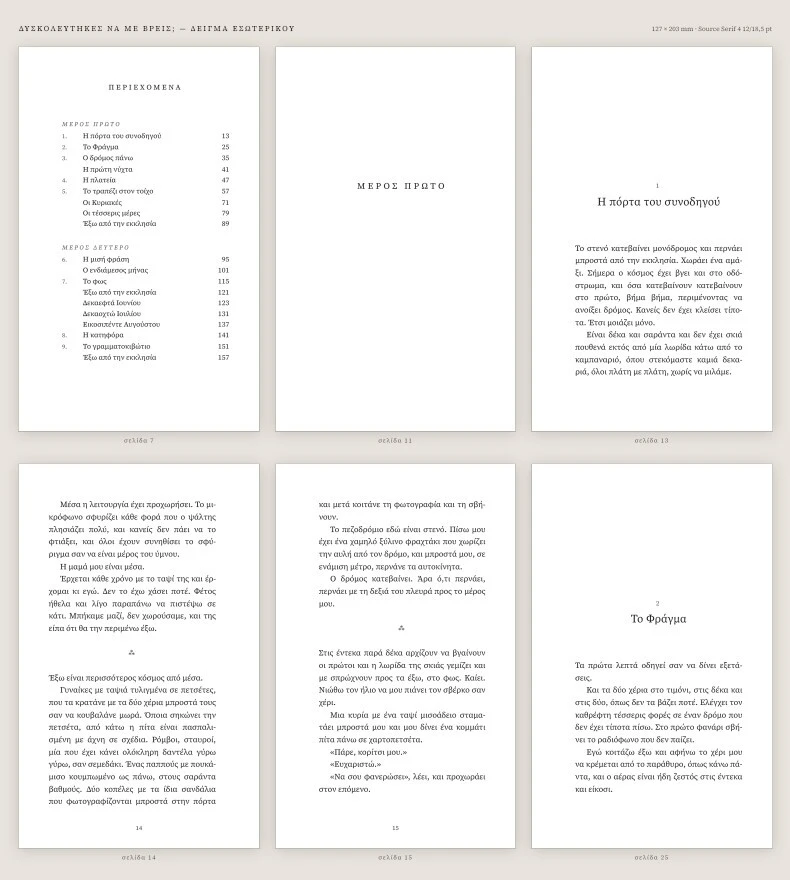
Selected interior pages showing the contents, chapter openings and typographic treatment of the Greek edition.
The final object combines generative writing, structural development, close editing, visual storytelling and publication design.
A New Direction Within an Evolving Practice
Δυσκολεύτηκες να με βρεις; does not represent a departure from the themes already present in my visual work. It approaches many of the same interests through a different medium: internal conflict, memory, absence, avoidance and the things people carry without expressing them directly.
What changed was the scale of the experiment.
Instead of constructing meaning through a single image or a short sequence, I had to maintain characters, place, rhythm and emotional continuity across an extended narrative. The process revealed both the capabilities of generative writing systems and the areas in which sustained human judgement remained essential.
It also changed the way I understand the boundaries of my own practice. Moving into fiction did not mean abandoning image-making. It meant applying the same interest in visual detail, psychological tension and narrative construction to a form built primarily through language.
The cover and book design then brought the project back into the visual field, completing a cycle between writing, image and physical publication.
The book will be independently published in Greek. It is also the beginning of a wider exploration. I am interested in repeating this process through different genres and narrative structures, not to prove that AI can replace writing, but to examine what kind of creative practice emerges when conception, generation, direction, editing and design no longer belong to clearly separated stages.
Continuing the Research
The completion of the novella does not mark the end of the experiment.
I am currently organising the working documents, successive versions and editorial observations produced throughout its development into a more focused practice-based study.
This next stage will examine the process in greater depth, including the role of situated human knowledge, the limits of generated prose, and the shifting boundaries between conception, generation, direction, editing and authorship.
The detailed analysis will be developed separately. It will include material that would reveal too much of the novella’s structure and narrative mechanism to present here before publication.
For now, Δυσκολεύτηκες να με βρεις; stands as the first completed outcome of that research.
This project is not a claim that I became a novelist overnight. It is evidence that an artistic practice can change form when an idea requires it, and that working with generative AI can become a demanding process of direction, questioning, revision and creative responsibility rather than a shortcut to a finished result.
The research is also intended to extend beyond my own practice. As it develops, I hope to translate the questions, methods and insights emerging from this process into workshops and interdisciplinary discussions in Veria, particularly in dialogue with fields such as creative writing, screenwriting and directing. These could become shared spaces for examining how generative AI affects voice, structure, authorship and creative control, allowing participants to test its possibilities, recognise its limitations and develop more conscious ways of working with it. In that sense, the novella is not only the outcome of a personal experiment, but a starting point for collective learning about how artistic practices may evolve alongside generative technologies.
Eleanna Tavlikou | Ennoia